

In recent years, EU sustainability and environmental policy has continued to expand in scope and ambition. This increasingly fruitful environmental agenda has also prompted heavy pushback during the current Commission mandate. With ten omnibus proposals already published and three more expected, “simplification” has become a recurring buzzword throughout the Brussels policy landscape. For many producers and brands, however, the dominant challenge is no longer the absence of regulation, but navigating overlapping rules, fragmented obligations and misaligned timelines.
Against this backdrop, the Environmental Omnibus, published in December 2025, was positioned as a first step towards simplification of Extended Producer Responsibility rules: a way to streamline and reduce administrative burden for companies placing products on the EU market while preserving, not weakening, the core obligations placed on producers to ensure sustainable waste management.
For those affected by Extended Producer Responsibility (EPR), packaging and packaging waste rules, and related files, expectations were high. The result, however, is a more modest intervention than many had anticipated.
In this article, we take a closer look at what the Environmental Omnibus actually does, what it changes for producers today, where it falls short, and how it fits into a broader reform trajectory that stretches well into the next legislative cycle.
What is the Environmental Omnibus, And What Was it Meant to Achieve?
The Environmental Omnibus is a targeted legislative initiative designed to amend and align specific provisions across existing EU environmental legislation. Rather than introducing new policy objectives, it aims to simplify implementation by adjusting reporting requirements, administrative processes and selected compliance obligations for companies.
In practice, the Omnibus is a relatively short document. Its ambition lies not in scale, but in intent: signalling that the European Commission recognises the growing complexity of environmental compliance and the cumulative burden this places on producers and brands operating across multiple Member States.
For Ohana’s clients, two areas are particularly relevant:
- Extended Producer Responsibility (EPR) via the Waste Framework Directive (WFD)
- Packaging and Packaging Waste Regulation (PPWR)
What The Environmental Omnibus Changes, And What it Doesn’t
Targeted simplification measures
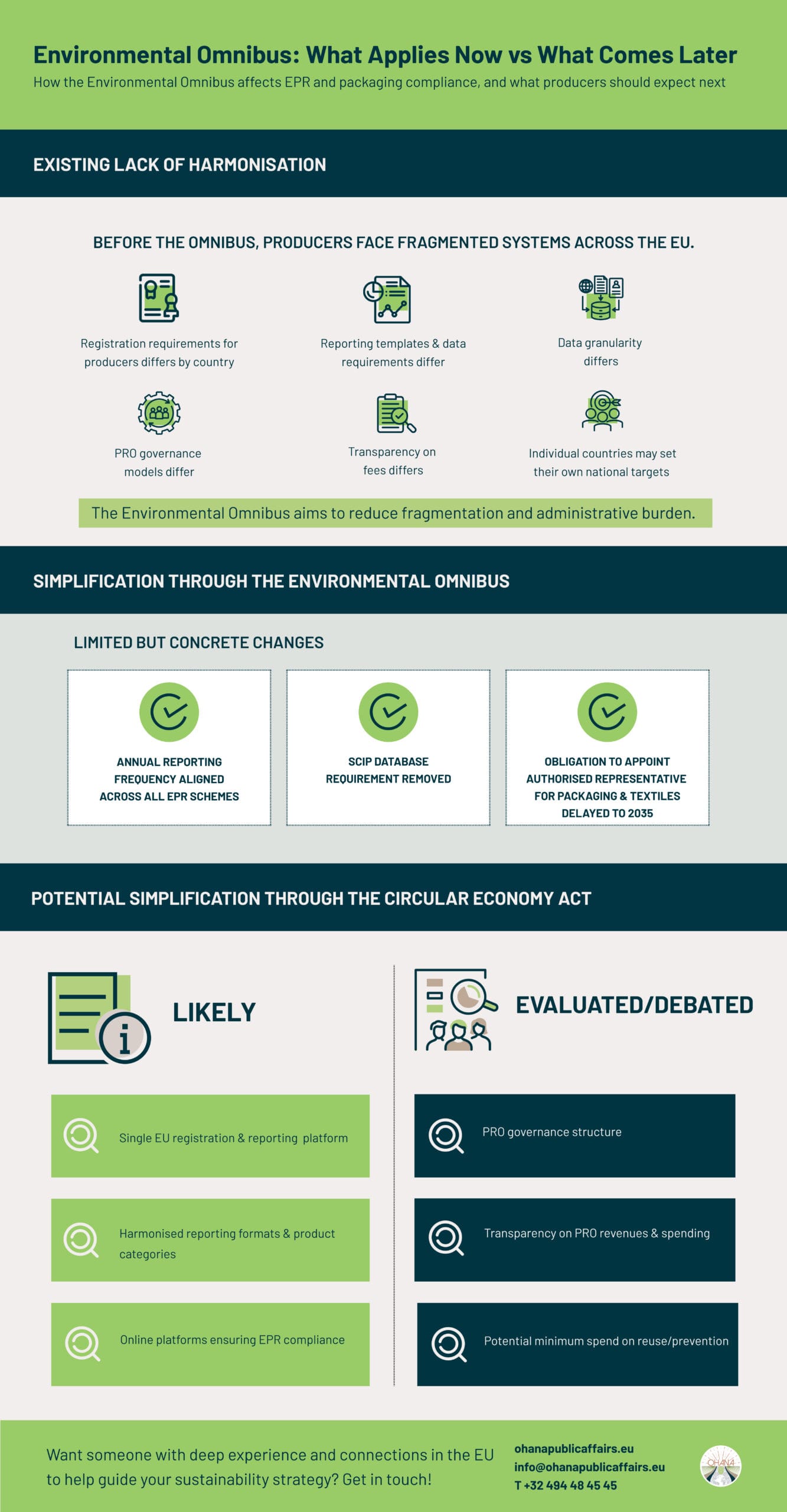
The Omnibus introduces a limited number of concrete changes intended to ease administrative pressure, including:
- alignment of annual reporting frequency across EPR schemes
- removal of the SCIP database obligation
- postponement of the obligation to appoint an authorised representative for packaging & textiles until 2035
These measures respond to long-standing concerns raised by industry, particularly around duplication, reporting fatigue, and inconsistent national practices.
At the same time, it’s important to be clear about what the Omnibus does not do.
- It does not fundamentally restructure EPR systems.
- It does not examine national EPR fee‑setting methodologies or move toward greater consistency in how fees are calculated across Member States.
- It does not assess the governance, accountability or transparency of Producer Responsibility Organisations, nor does it clarify the roles and responsibilities of other key actors such as collectors, sorters and recyclers.
The simplification delivered is real, but narrow.
Why The Environmental Omnibus Falls Short For Producers
The limitations of the Environmental Omnibus are less about its content than about timing and scope.
Many of the deeper simplification measures producers have been calling for, such as:
- a single EU-wide EPR registration platform
- harmonised reporting formats
- clearer and more consistent fee modulation criteria
have been deferred to future initiatives, most notably the Circular Economy Act, expected in September 2026.
This creates a structural challenge for producers.
EPR and packaging obligations begin to apply well before those broader reforms are expected to take effect. In many cases:
- new requirements will roll out between 2026 for packaging and 2028 for textiles
- meaningful structural simplification may only materialise in 2028–2030 or later
The result is a timing mismatch: producers are required to comply early, while the benefits of simplification arrive much later.
What This Means in Practice For Producers And Brands
From a compliance perspective, the Environmental Omnibus sends a clear signal: waiting is not an option.
While future reforms may improve the system, current obligations will apply regardless. For producers and brands, this means:
- understanding existing EPR for textiles and packaging requirements as they stand today
- mapping obligations and entry-into-force dates across Member States
- preparing internal systems, data flows and governance structures in advance
At the same time, the Omnibus should be read as part of a longer reform trajectory, not an endpoint. Monitoring the development of the Circular Economy Act and related initiatives will be critical, particularly for organisations seeking to future-proof compliance strategies and avoid repeated reconfiguration.
A Step in a Longer Journey
The Environmental Omnibus reflects a growing recognition at EU level that environmental regulation must be not only ambitious, but also implementable. As such, it represents an important — if limited — first step towards simplification.
For producers, the key challenge is navigating a period where:
- obligations continue to expand
- simplification arrives incrementally
- timelines remain misaligned
Understanding where the Omnibus fits into this wider picture helps set realistic expectations: some relief is coming, but not all at once, and not soon enough to delay action today.
Looking Ahead
The real test of the Environmental Omnibus will be whether it paves the way for deeper reform. Much now depends on how forthcoming initiatives, particularly the Circular Economy Act, address the structural issues that remain unresolved.
In the meantime, clarity, anticipation and coordination across legal, sustainability and operational teams will be essential.
At Ohana, we support organisations in making sense of this evolving landscape, helping them interpret fragmented legislation, align compliance timelines and anticipate what is coming next, so that today’s decisions remain robust as tomorrow’s reforms take shape.
If you would like to explore how the environmental omnibus affects your organisation’s compliance or policy planning, get in touch with our experts at Ohana to continue the conversation.