


The circular economy has become one of the defining pillars of EU environmental policy. At its core lies a simple idea: products, components and materials should remain in use for as long as possible and retain their value throughout their lifecycle.
Over the past decade, the European Union has translated this principle into a growing body of legislation aimed at transforming how products are designed, used and managed at the end of their life. While the textile sector has received significant attention in recent years, it is only one part of a much broader policy landscape.
A wide range of sectors, from electronics and vehicles to packaging, batteries and pharmaceuticals, are now covered by circular economy policies. Understanding how these different initiatives fit together is becoming increasingly important for companies operating across the EU market.
In this article, we take a step back and look at the bigger picture: how EU circular economy policy has evolved, which sectors are affected, and where the policy agenda is heading next.
Want someone with deep experience and connections in the EU to help guide your sustainability strategy? Get in touch!
Mapping The EU’s Circular Economy Policy Landscape
The EU’s circular economy framework is evolving rapidly, with policies addressing different stages of the product lifecycle — from design to end-of-life management — and affecting a growing number of sectors.
The infographic below provides an overarching overview of how these policies interact and where future initiatives may emerge.
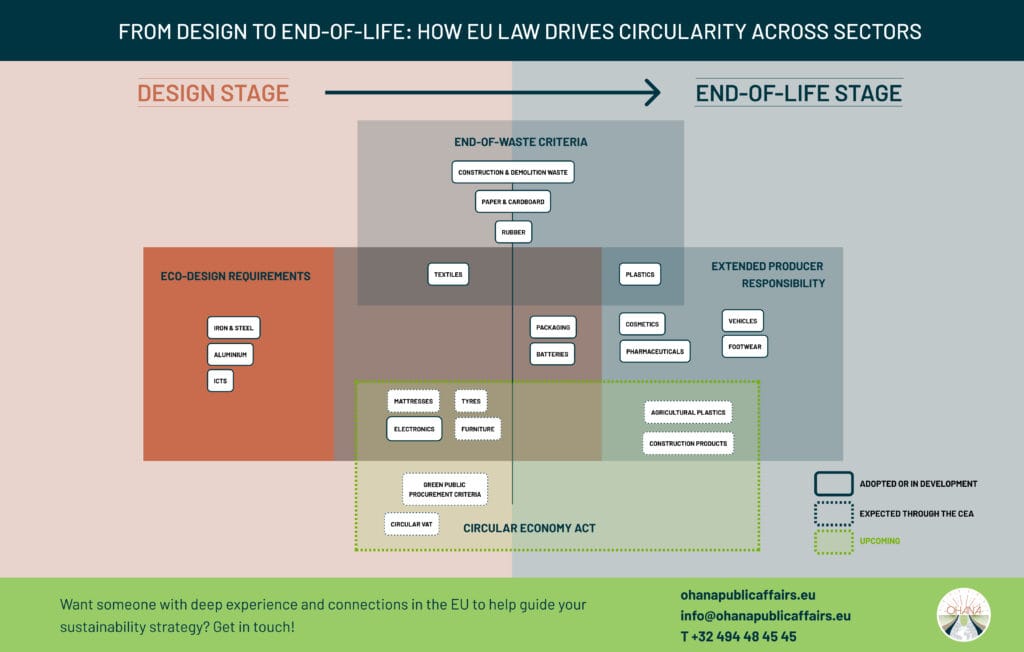
The diagram highlights three key dimensions of EU circular economy policy:
- Design-stage policies, such as eco-design requirements introduced through the Eco-design Directive and the Ecodesign for Sustainable Products Regulation (ESPR) for specific product groups;
- End-of-life measures, including Extended Producer Responsibility (EPR) schemes that make producers financially responsible for the collection, sorting and and treatment of waste;
- Future enabling policies, designed to complement existing measures by introducing notably new financial incentives or leveraging public procurement to drive the transition toward circular business models. Together, these elements illustrate how the EU is gradually building a comprehensive framework that encourages circularity across the entire product lifecycle.
From Waste Management To Product Design
Historically, EU circular economy policy began with a focus on waste management.
Early legislation was designed to ensure that products were properly collected, treated and recycled once they became waste. A central tool in this framework is Extended Producer Responsibility (EPR), a system that requires producers to finance the waste management associated with their products.
In simple terms, EPR shifts the cost of waste management away from municipalities and taxpayers and places it on the producers who put products on the market. For concrete examples, take a look at our analysis of EPRs in France and the Netherlands.
Over time, this approach has been implemented sector by sector, with EU legislation targeting specific product categories and their supply chains.
Today, the EU has seven major EU-wide EPR schemes, covering areas such as:
- Packaging
- Single-use plastics
- Batteries
- Electrical and electronic equipment
- Vehicles
- Textiles and footwear
- Wastewater from pharmaceuticals and cosmetics
This sector-specific approach explains why EU circular economy policy often appears fragmented: different product groups are regulated through separate directives or regulations, each addressing the environmental challenges unique to that sector.
A Growing Architecture Of Circular Economy Legislation
Several key pieces of legislation illustrate how the EU has progressively expanded circular economy rules across sectors.
One of the earliest examples is the Packaging and Packaging Waste Directive, adopted in 1994. It introduced EU-wide recovery and recycling targets and laid the groundwork for producer responsibility schemes for packaging across Member States. Its recent revision, the Packaging and Packaging Waste Regulation (PPWR), aims to harmonise packaging requirements across the EU while introducing stronger sustainability requirements on packaging placed on the EU market.
Similarly, the End-of-Life Vehicles Directive, adopted in 2000, introduced producer responsibility for vehicles and established rules for vehicle dismantling and recycling. A revision currently under negotiation seeks to strengthen these requirements and introduce recycled content targets.
Electronics are governed by the Waste Electrical and Electronic Equipment Directive (WEEE), adopted in 2002 and updated in 2012. The Commission is expected to review the framework again this year as part of the upcoming Circular Economy Act.
Another major step was the transformation of the Batteries Directive into the Batteries Regulation in 2023, which introduced harmonised requirements across the battery lifecycle, including sustainability and recycling obligations.
The Single-Use Plastics Directive, adopted in 2019, introduced restrictions and producer responsibility requirements for several plastic products, including PET bottles. The European Commission is expected to publish its evaluation of the directive by July 2027, which may lead to a subsequent revision.
Finally, the Urban Waste Water Treatment Directive, originally adopted in 1991 and revised in 2024, introduced a new form of producer responsibility for pharmaceuticals and cosmetics manufacturers. Under the revised rules, these producers must finance the advanced treatment needed to remove micropollutants from urban wastewater.
Unlike traditional EPR schemes that focus on the waste management of products, this system addresses environmental impacts during the use phase of products, by linking the presence of specific residues found in wastewater to the products placed on the EU market. This illustrates how circular economy policy continues to evolve.
The Next Frontier: Designing Products For Circularity
While early circular economy policies focused on waste management, the EU has increasingly turned its attention to product design.
The first step in this direction was the Ecodesign Directive, adopted in 2005, which initially targeted energy-related products such as household appliances. Its objective was to reduce environmental impacts across the product lifecycle by setting design requirements.
This framework is now being significantly expanded through the Ecodesign for Sustainable Products Regulation (ESPR), adopted in 2024.
The ESPR allows the EU to introduce sustainability requirements for a wide range of product groups, including:
- Steel and aluminium
- Apparel
- Furniture
- Tyres
- Electronics
These rules aim to make products more durable, repairable and recyclable, addressing environmental impacts long before products reach the waste stage.
Alongside ecodesign rules, eco-modulation has emerged as a key policy tool. Under this system, the fees that producers into extended producer responsibility schemes (such as for electronics or textiles) pay to producer responsibility organisations can be adjusted based on the environmental performance of their products.
Products designed to last longer or that use more sustainable materials may benefit from reduced fees, while less sustainable products may face higher contributions. In this way, eco-modulation creates a financial incentive for companies to invest in better product design.
What Comes Next: The Circular Economy Act
Looking ahead, the EU is preparing the next phase of its circular economy agenda.
The Circular Economy Act (CEA), expected in 2026, is likely to build on existing legislation while exploring new policy tools aimed at strengthening markets for circular products and materials.
This may include expanding EPR schemes to additional product categories such as:
- Mattresses
- Furniture
- Tyres
- Construction products
- Agricultural plastics
Beyond regulatory requirements, the CEA could also introduce new demand-side measures designed to accelerate the uptake of recycled and circular materials.
Examples under discussion include:
- Fiscal incentives such as reduced VAT for products with recycled content
- Taxes on landfill or incineration
- Recycled content requirements in additional product categories
- Public procurement criteria for circular products
- Support for repair, reuse and product-as-a-service models
These tools reflect a growing recognition that regulation alone is not enough. Stronger market incentives are also needed to increase the use of secondary raw materials and stimulate investment in circular solutions and recycling solutions.
The Political Context: Ambition Meets Competitiveness
The rapid expansion of circular economy legislation was a defining feature of the first von der Leyen Commission, which introduced a wide range of flagship initiatives including the ESPR, PPWR and revisions to major waste directives.
Today, the focus is shifting toward implementation.
At the same time, the political context has evolved. Concerns about competitiveness, administrative burden and global economic pressures have made the development of new environmental legislation more complex.
Circularity is increasingly framed not only as an environmental objective but also as a pillar of industrial competitiveness, particularly as the EU seeks to secure access to critical raw materials and strengthen domestic supply chains.
This evolving political context is reflected in ongoing discussions around simplification initiatives, enforcement of EU rules and concerns about unfair competition from non-EU producers.
A Growing But Complex Policy Landscape
As the EU circular economy framework expands across sectors, one challenge becomes increasingly clear: policy fragmentation.
Different product groups are regulated through separate directives and regulations, often with different timelines and implementation mechanisms. This can make it difficult for companies operating across multiple sectors to maintain a clear overview of their obligations.
At the same time, effective enforcement remains critical. Without strong enforcement, there is a risk that companies investing in sustainable practices face unfair competition from producers who do not comply with EU rules.
Despite these challenges, circularity is becoming a structural feature of EU product policy, affecting more sectors and more stages of the product lifecycle.
Looking Beyond Textiles
For companies already navigating circularity requirements in the textile sector, this broader policy landscape offers an important perspective.
The EU is not regulating circularity one industry at a time in isolation. Instead, it is gradually building a comprehensive framework that links product design, waste management and market incentives across the economy.
Understanding how these policies connect, and how they may evolve in the coming years, will be essential for companies operating in Europe’s increasingly circular economy.
At Ohana, our core expertise lies in the textiles and agri-food sectors, where we already support organisations in navigating complex and fast-moving EU sustainability legislation. At the same time, we actively monitor developments across a much wider range of sectors, from packaging and electronics to construction and chemicals, reflecting the increasingly cross-sector nature of circular economy policy.
As this policy landscape continues to evolve, so do we. If your organisation is preparing for new circular economy requirements — whether in textiles or beyond — our team can help you map the evolving policy landscape, understand what applies to your sector, and build a clear roadmap for compliance and long-term sustainability.