


Forced Labour Regulation: judged on the result, but evidence is key
Under the EU’s Forced Labour Regulation, it won’t be enough to have tried to eradicate forced labour from a supply chain. Companies will have to ensure that their products are free of forced labour. The European Commission’s new guidelines offer a clearer picture of how the ban will be enforced, and what companies will need to show when it is.
The European Commission published its guidelines on the EU Forced Labour Regulation (FLR) (Regulation (EU) 2024/3015) in July, ahead of its application on 14 December 2027. The Regulation bans products made with forced labour from entering, circulating or leaving the EU market. To help shed light on the implementation of the legislation, the Commission is hosting a series of webinars, in the second half of this year, with a focus on high impact sectors such as food, textiles, batteries, electronics, fisheries and more.
The Commission’s guidelines, though non-binding, offer clarification on how the new ban will work in practice for companies, authorities and other stakeholders. For business, they signal how the Regulation will be enforced, including the types of products and supply chains that may attract greater scrutiny.
What is Forced Labour?
The Regulation uses the ILO definition:
all work or service extracted from a person under the threat of a penalty, and which they have not offered voluntarily. Indicators include deception, debt exploitation, withheld wages, retained identity documents and threats. State-imposed forced labour, where the coercion comes from public authorities, is a particular enforcement priority.
Tainted by forced labour: a compliance programme is not enough
The FLR imposes, in legal terms, a so-called “obligation of result”, rather than “an obligation of means”. Effectively, this means that the Regulation does not ask companies to show they tried, it requires them to ensure their products are “clean”. Practically, this means that having a compliance programme in place alone isn’t a defence.
Who and what is implicated by the FLR?
- There is no company size threshold, so SMEs are included in the scope of the Regulation (although larger companies may face greater scrutiny)
- It will apply at any stage of the supply chain, e.g. extraction, harvest, production or manufacture. Transportation is excluded.
- It will apply to all product parts
- It includes selling products both in stores and through online platforms. Any product “placed on the EU market” is in scope.
- Not only goods that are imported or exported from the EU are covered. Stock already in warehouses or on shelves is covered after 14 December 2027.
- Ban decisions apply to all identical products, whoever places them on the market. Therefore, an importer or distributor that was not the subject of the original investigation may face enforcement action if it places on the market a product already covered by an existing ban decision.
Where will scrutiny fall?
Authorities will weigh three factors together to decide which products to prioritise for the investigation: the scale and severity of the suspected forced labour, the volume of the product on the EU market, and how much of the final product is made with the suspect part or material. They will also look at which companies are best placed to act, meaning those closest to the forced labour and with the most leverage over it. Where the forced labour is outside the EU, importers are likely to be a key focus. State-imposed forced labour and child forced labour is treated as especially serious.
Below are the steps of the investigation process to be followed by the Infograph.
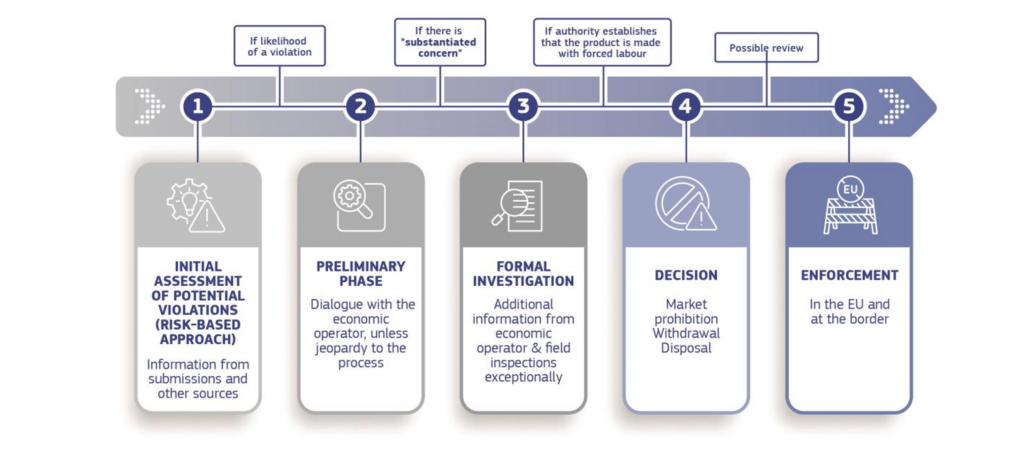
Infographic by European Commission
The paradox: due diligence voluntary on paper, decisive in practice
The Regulation imposes no due diligence duty, and the guidelines say that other approaches can work too: traceability, responsible purchasing, certification, worker-driven monitoring. And so due diligence remains voluntary, but – in reality – it becomes critically important. This tension becomes clear from the guidelines’ detailed, non-exhaustive list of what authorities may ask for, at both the preliminary and investigation stages: company policies, supplier contracts and codes of conduct, records of internal training, risk assessments, supply chain maps and traceability records, and proof that grievance mechanisms and remediation actually work.
When considering an investigation into forced labour concerns, authorities will look at the quality and credibility of what a company has done when deciding whether a concern is “substantiated”. Therefore, not having credible due diligence in place is likely to increase the risk of an investigation, in our view. The Commission’s guidelines follow the six-step framework of the OECD Due Diligence Guidance for Responsible Business Conduct, and so for companies seeking to benchmark their due diligence, this is a good place to start. The guidelines indicate potential company actions per each of the 6 steps of due diligence.
FLR enforcement comes into focus
In September 2026, the Commission hosted a webinar (the first in a series: “From challenge to action: get ready for the FLR implementation”), which offered some signals about how enforcement may look like. Five key points stood out for us.
Role of certifications and industry initiatives: Authorities recognise the value of certifications, audits, and collaborative industry initiatives, although their evidentiary weight will be assessed on a case-by-case basis. Social audits conducted in areas where state-imposed forced labour risks have been identified may have limited credibility due to the challenges in obtaining reliable and independent information. The Commission may provide further guidance in the future on how companies can identify credible initiatives and certification schemes.
Information Requests During Investigations: Investigations will be confidential, risk-based and evidence-driven, relying on the triangulation of multiple information sources that authorities can get and dialogue with companies. The documentation requested by competent authorities will be tailored to the specific circumstances of each case. Authorities will consider factors such as a company’s position in the supply chain and its proximity to the alleged forced labour risk. Existing due diligence efforts, including those undertaken to comply with legislation such as the CSDDD or the Batteries Regulation, will also be taken into account.
Assessment of State-Imposed Forced Labour: Where state-imposed forced labour has been documented in a specific region, evidence obtained by the competent authorities in one case, may be considered relevant to other cases involving that region. The Commission indicated that the regional context will play an important role in risk assessments.
Remediation and Dialogue with Companies: The existence of forced labour in a supply chain will not automatically lead to enforcement action without engagement. Authorities will maintain a dialogue with companies and apply a risk-based approach that considers factors such as the severity of the risk and the company’s efforts to identify, prevent, and remediate issues. If in spite of good efforts, there is still forced labour in the supply chain, during the investigation there will be dialogue and room for remediation. Meaningful due diligence and remediation efforts will be viewed positively.
Tools and Risk Identification: Collaboration with NGOs
The Forced Labour Risk Database
The Forced Labour Risk Database is currently under development. The database will draw on a broad range of verified public sources, including international organisations such as the ILO and OECD, national ministries, competent authorities, and research institutes, which will undergo “rigourous verification”. But the timeline for the database remains uncertain.
The inclusion of a product, sector, or geographic area in the forced labour risk database will not automatically trigger an investigation. Authorities will consider a range of additional factors, and the database will serve as one element within a broader risk assessment framework. Ultimately, it will come back to due diligence, which as we have seen is not so “voluntary” – it will be the effort and evidence that will count in judging whether a company is investigated and how it goes.
Next steps for business to ensure FLR compliance
Business can already prepare, by:
- Internal organisation: Designating a contact person or team and an escalation route for authority requests. Preparing scenarios for stopping or recalling affected batches to avoid a broader action and replacing a part of the goods affected by the forced labour.
- Mapping the available documentation: Testing existing practices and documentation against the guidelines’ list of documents an authority may request.
- Deeper evidence for higher-risk situations: Starting with high-risk products and geographies, check detailed evidence is available there. You might need to come up with a combination of actions to illustrate your efforts to address and mitigate the risk, such as furthering your traceability actions, social audits, collaboration with NGOs, etc.
Forced Labour Regulation: practical questions remain
The guidelines are a step towards implementation, and we now have some clarity on risk-based enforcement, the role of company due diligence, and the investigation process. But there is still considerable uncertainty about how the regime will operate in practice.
There are several moving parts we’ll be watching closely: When will the Forced Labour Risk Database be ready? Will the Commission issue additional guidance as requested by civil society groups? How will national penalty regimes due to be notified by 14 December 2026, be set? How consistently will Member States enforce the FLR? If you’d like to talk about getting ready for the Forced Labour Regulation, get in touch.
Further reading: