


As 2025 draws to a close, we have seen the first full year of a new European Commission that has clearly set a different tone and priorities compared to the previous mandate. The renewed emphasis on competitiveness, resilience and strategic autonomy has led some to question whether sustainability is losing ground in the EU policy agenda. While it’s true that the political climate has shifted, it would be a mistake for companies to assume that sustainability legislation is no longer central to the EU’s direction of travel.
Across the textiles sector, sustainability rules continue to move forward, even when certain files have been reopened or delayed in the name of simplification. This means that businesses cannot afford to take their eyes off policy developments. As consumer expectations rise, sustainability is not only a regulatory issue but also a commercial and strategic one. Products placed on the EU market must continue to become more circular, more transparent and more aligned with environmental objectives.
In this end of year recap, we look back at 2025 through the lens of textile sustainability legislation. We review the most important developments and assess what they mean for the industry. We then turn to 2026 to examine what businesses should expect and where to focus their attention as the sector continues its transition into a highly regulated environment.
Want someone with deep experience and connections in the EU to help guide your sustainability strategy? Get in touch!
2025: Key Themes and The Political Context
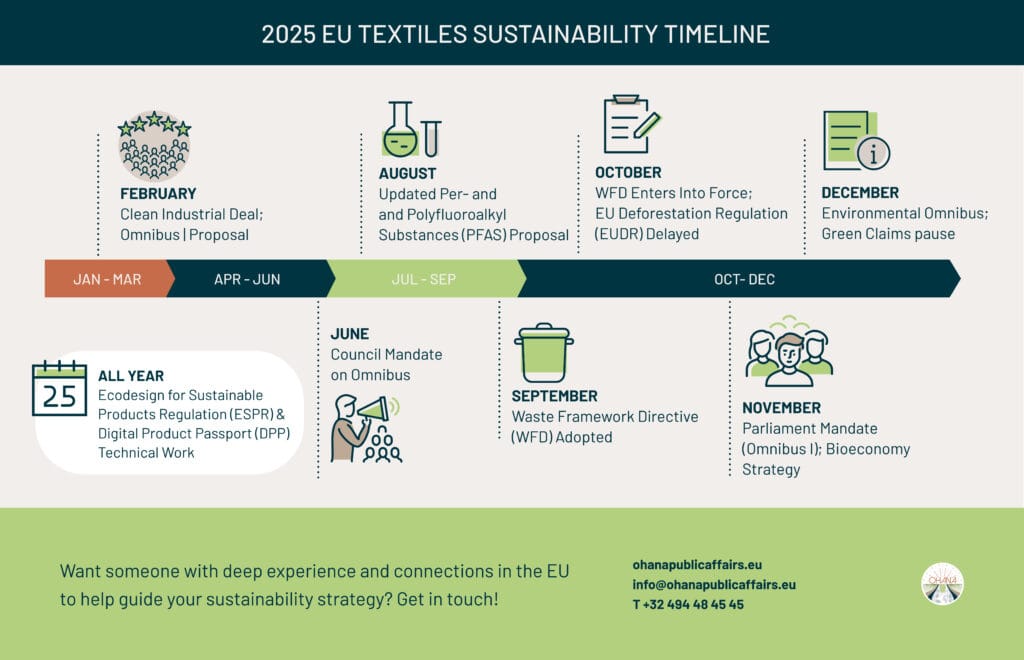
The year 2025 marked the beginning of the new Commission’s mandate. It immediately distinguished itself from its predecessor. As mentioned, the geopolitical landscape has pushed the EU to prioritise economic resilience, competitiveness and strategic autonomy. As a way to support this shift, the Commission has framed simplification as a core political priority. Several pieces of sustainability legislation that were agreed only a few years ago were reopened to streamline requirements and reduce administrative burdens.
While this may ease pressure for some companies, it has not brought the regulatory certainty that businesses had hoped for. Reopening files has extended timelines and created new uncertainty across sectors that had already started preparing for implementation. At the same time, other sustainability proposals continue to advance, and several laws adopted in previous years have now entered the implementation stage.
A major moment for this mandate came in February 2025 with the publication of the Clean Industrial Deal. This communication laid out the Commission’s broader agenda for industrial competitiveness and innovation, providing the backdrop against which all other initiatives are now viewed. Circularity remains aligned with this industrial strategy, as the Commission continues to emphasise the need for resource efficiency and responsible supply chains as part of a competitive European market.
In short, 2025 was a year of both consolidation and reopening. Companies must navigate a landscape where the drive to simplify intersects with the continued rollout of transformative sustainability rules.
EU Sustainability Law for Textiles: Analysing 2025’s Main Events
For the textile sector in particular, the past year brought several decisive developments, which we will review next.
Waste Framework Directive
One of the most consequential developments for the textile industry was the adoption of the revised Waste Framework Directive (WFD). Adopted in September and entering into force in October 2025, the new WFD makes Extended Producer Responsibility (EPR) schemes mandatory across the EU for textiles, footwear, accessories and home textiles. This shifts responsibility for the end of life of textile products directly onto producers.
All Member States must transpose the WFD into national legislation and establish their EPR schemes by April 2028. While this timeline gives companies and Member States some preparation time, the impact on the sector is significant. The success of these schemes will depend greatly on how harmonised their design becomes across the EU, and how they are financed at national level.
“In 2025, the EU took a decisive step by introducing Extended Producer Responsibility for the textile industry, holding brands accountable for the end-of-life of their products and aiming to preserve the material value of existing goods. As we enter 2026, the challenge will shift to the national stage: preventing fragmentation and uneven implementation across Member States. Yet, another pressing question looms: will EPR schemes, to be finalised by 2028, arrive too late for a sector already on the brink, as textile sorters and recyclers are working hard to scale their businesses and innovations?” – Clelia, Junior Consultant, Circularity & Chemicals Team
Ecodesign for Sustainable Products Regulation and the Digital Product Passport
In regards to the Ecodesign for Sustainable Products Regulation (ESPR), the Commission’s technical work on eco-design requirements for textiles, carried out through the Joint Research Centre, continued throughout 2025 but progressed more slowly than originally planned. For textiles, the future eco-design measures will be central. They will shape how companies design their products, which fibres they use (e.g. recycled fibres), what durability requirements they must meet and what information they must disclose.
In 2026, the technical work will continue. Further consultations are expected, including engagement with the Ecodesign Forum. The adoption of the final rules is currently planned for the second quarter of 2027, although delays remain possible.
“The ongoing, highly technical work on textile eco-design rules under the ESPR and Digital Product Passport is crucial, as it positions the EU to drive the fundamental, sector-wide changes needed for a sustainable future. To translate this admirable ambition into tangible impact, ensuring the eventual requirements align effectively with both existing and upcoming initiatives, as well as being rooted in business reality, is paramount for enabling widespread industry adoption and a globally transformative outcome.” – Analoli, Consultant, Circularity & Chemicals Team
For companies, 2026 will be a critical year to participate in consultations and follow the technical materials shaping the final requirements.
Omnibus I On Corporate Reporting & Due Diligence
The Omnibus I proposal advanced significantly in 2025. For those new to the omnibus concept: an omnibus is essentially a legislative initiative that amends several other pieces of legislation. This horizontal package aims to simplify several sustainability laws, which has resulted in a substantial reduction in the number of companies in scope of both the Corporate Sustainability Due Diligence Directive (CSDDD) and the Corporate Sustainability Reporting Directive (CSRD).
For the textile sector, this means that only the very largest companies will remain in scope for mandatory due diligence and sustainability reporting. Many fashion and textile companies will find themselves excluded. However, this does not remove the value of due diligence as a governance tool, nor the expectation from business partners and investors that companies operate transparently.
In 2026, the final negotiations will take place. Once concluded, the Commission will restart work on guidance documents covering best practices for due diligence, impact prioritisation, data exchange and penalties. Depending on the final agreement, in-scope companies will begin compliance either in 2028 or 2029. Companies that fall out of scope will still benefit from aligning with the voluntary OECD Guidelines for Multinational Enterprises, particularly to strengthen supply chain resilience.
“While some simplification is welcome, the revisions proposed by the Omnibus I are excluding a wide range of companies and penalising the frontrunners. Investors and companies in-scope might be missing the sustainability information from companies not in scope due to carve-outs. It remains to be seen how the Voluntary SME standard (to be used by not-in-scope companies) will be revised to ensure that the crucial data is captured.” – Natalia, Head of Transparency & Supply Chain Team
Green Claims Directive
The Green Claims Directive (GCD), long anticipated as a tool to govern environmental claims across sectors, was put on hold in 2025. Concerns that the verification requirements might be too burdensome for companies stalled the negotiations.
For the textile sector, this uncertainty leaves a lack of clarity on how sustainability information should be substantiated. However, the Empowering Consumers for the Green Transition Directive is already in place and contains requirements companies must follow when communicating environmental claims.
“The pause and the likely withdrawal of the GCD is disappointing for many in the textile sector. After years of discussion, we were hoping for clearer guardrails on how to communicate sustainability claims with confidence. But this doesn’t mean we’re left without direction. The rules under the Empowering Consumers Directive still apply, and companies can already build on existing good practices to stay transparent and honest with consumers.” – Francesca, Senior Consultant, Transparency & Supply Chain Team
Universal PFAS Restriction
In 2025, the European Chemicals Agency (ECHA) presented the updated universal PFAS restriction proposal, which includes apparel. The draft foresees a strict ban for new textile products containing PFAS, with a derogation foreseen for recycled and secondhand textiles. For brands that have not yet phased out PFAS, securing alternatives should now be a priority.
In 2026, the final ECHA assessment and the last public consultation are expected. Companies will need to prepare for changes in product testing, sourcing and production, especially given the complexity of identifying PFAS across long and fragmented supply chains.
“This year showed that for textile products, the upcoming universal PFAS ban is on track and is expected to be adopted in the next few years. Textile and fashion companies who have not phased out PFAS yet, are advised to start testing for PFAS accordingly, and change production processes and sourcing along the supply chain. Preparing in advance for PFAS substitution takes time, but can also create an important competitive advantage.” – Vittorio, Public Affairs Assistant, Circularity & Chemicals Team
EU Deforestation Regulation
The EU Deforestation Regulation (EUDR) underwent further adjustments in 2025, with deadlines delayed again and obligations reduced for SMEs. The Commission was originally expected to review whether the Regulation should be expanded to additional commodities, but this review may also be postponed.
For those textile companies in scope, which had already started preparing for potential compliance due to leather’s inclusion in the original scope, the shifting timelines create significant uncertainty.
Looking ahead, we expect a possible review in April 2026, potentially paving the way for further simplification.
“The revision of EUDR is consistent with the Commission’s approach to simplification: streamlining compliance obligations while postponing entry into force to give more time for companies to prepare. Contrary to other simplification initiatives, few accuse the revision to be deregulation, despite environmental concerns on the delay of anti-deforestation rules.” – Arthur, Public Affairs Assistant, Transparency & Supply Chain Team
Bioeconomy Strategy
In late November 2025, the European Commission presented its new Bioeconomy Strategy, setting out a roadmap to scale Europe’s bio based economy, reduce fossil fuel dependence and support rural development. Although non legislative, it outlines plans to stimulate innovation, create lead markets for bio based materials and ensure a sustainable supply of biomass.
Textiles are directly referenced, with bio based fibres identified with a potential for creation of lead markets. Natural fibres such as cotton, flax, hemp and wool, as well as man made cellulosic fibres from sustainably managed forests, are highlighted for their potential to provide reliable and traceable feedstocks and strengthen regional value chains.
In 2026, several linked initiatives will shape implementation. The revision of the Product Environmental Footprint (PEF) methods, expected by the fourth quarter, will integrate indicators relevant to fibre performance and microfibre release. The Biotech Act, planned for the third quarter, aims to simplify regulatory requirements to speed up bio based innovation. The Strategy also notes that the ESPR (referenced above) will introduce performance and durability requirements for textiles, including bio based materials.
“With key files landing in 2026, including the eco-design rules for apparel (ESPR), Biotech Act and potentially the PEF revision, next year will be critical in determining how quickly bio-based textiles can scale across Europe.” – Francesca, Senior Consultant, Transparency & Supply Chain Team
Upcoming Events: What to Expect in 2026
Although the legislative wave for textiles may be smaller in 2026 compared to recent years, the sector’s transition into a regulated industry is far from slowing down. Simplification will continue to shape policy discussions, but it will not halt the broader sustainability trajectory. Companies will still face substantial new requirements and must remain closely engaged.
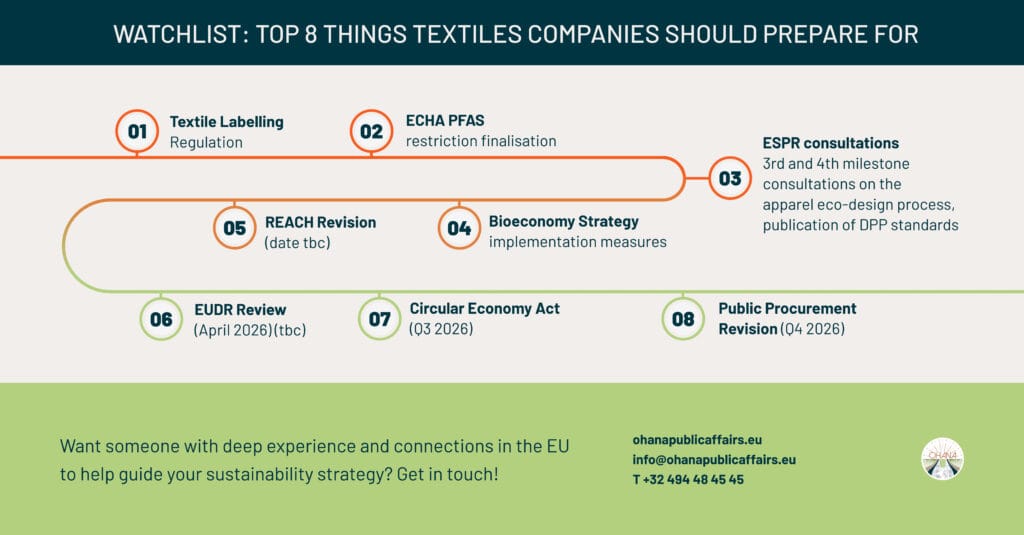
Key developments to expect include:
Textile Labelling Regulation (TLR)
After significant delays, the revised Textile Labelling Regulation (TLR) is now expected in the first half of 2026. The proposal will modernise the current framework. Likely elements include digital labelling in addition to physical labels, potential harmonisation of sizing systems and mandatory care labelling. Sustainability-related information may also be included. For textile companies, this will affect both product development and market communication.
Circular Economy Act
Expected in the third quarter of 2025, the Circular Economy Act will become increasingly relevant in 2026 as discussions and preparatory work progress. It aims to bring together existing circularity initiatives under a more coherent framework. For textiles, the Act could reinforce obligations linked to improving the business case of second hand and recycling of textile waste.
Environmental Omnibus
Published on 10 December 2025, the Environmental Omnibus aims to reduce administrative burdens linked to environmental reporting. For the textile sector, the most relevant elements relate to EPR reporting and the removal of the SCIP database. This could ease compliance, although details on implementation will determine the practical benefits.
Public Procurement Revision
Expected in the second quarter of 2026, the revision of EU public procurement rules aims to simplify participation and make it easier for SMEs to bid. For textile companies, especially those producing uniforms or workwear, this could unlock new opportunities in public tenders, particularly as sustainability criteria become more common in procurement processes.
REACH Revision
Originally planned for late 2025, the REACH revision is now expected to be delayed into 2026. The goal is to simplify rules while maintaining environmental integrity. For textiles, the implications remain uncertain but could influence the chemical management requirements that underpin material choices, dyeing processes and finishing techniques.
Key Takeaways
“The EU’s current mandate has certainly confirmed its commitment to simplify and reduce admin burdens on companies. For the textile industry, the EU’s political effort is expected to influence all regulations relevant for the sector; for some more directly, others more indirectly. At the same time, regulatory developments are continuing and the textile industry is still expected to transform into becoming a regulated sector also from a sustainability point of view.” – Rannveig, Head of Circularity & Chemicals Team
The developments of 2025 showed that while the political context in Brussels has shifted, the EU’s sustainability agenda remains firmly in place. The drive to simplify legislation has not replaced the need for companies to engage with increasingly technical rules on design, materials, waste and supply chains. If anything, the interaction between simplification and sustainability has made the landscape more complex.
As we move into 2026, we believe that businesses should not mistake political caution for a retreat from environmental ambition. The EU continues to demand more transparency, more circularity and more responsible production practices. In a context where more conservative voices are becoming louder, it’s important that progressive and sustainability driven actors also make themselves heard to keep advancing Europe’s green transition.
To navigate what comes next, companies must remain informed, connected and proactive. You can stay up to date by signing up to our newsletter, exploring our Basecamp platform and reaching out to us to find out more about our tailored webinars and support on upcoming legislation.
Stay tuned for our next blog article, where we examine what’s coming in 2026 for the agri-food sector, which is undergoing its own major transformation.