

EU traceability and transparency requirements are moving beyond traditional compliance and toward verifiable supply-chain data. From the EU Deforestation Regulation to the future Digital Product Passport, companies are increasingly expected to show where products come from, how they were made, and whether sustainability-related claims can be supported. This shift is no longer limited to agri-food. It is spreading across sectors and is becoming a practical condition for market access, reporting, and regulatory resilience in the EU.
This evolution is not only about enforcement. It also reflects a broader policy ambition: to modernise value chains, move away from fragmented, manual information handling, and accelerate digital transformation across industries.
At the centre of this shift lies the growing interplay between traceability – which generates data – and transparency – which determines how that data can be used by regulators, markets, and consumers. Together, they underpin market access, regulatory compliance, and corporate credibility.
As the EU prepares both the review of the EU Deforestation Regulation (EUDR) and the rollout of the Digital Product Passport (DPP) under the Ecodesign for Sustainable Products Regulation (ESPR), this article explains how EU transparency and traceability requirements are evolving and expanding (far beyond agri-food), which regulations are driving the shift, and what companies should do now to prepare. Part two in this series of articles will take a deeper dive into how the Digital Product Passport fits into the picture.
From Food Safety to Proof of Sustainability
Traditional traceability: managing risk, not responsibility
Historically, EU traceability requirements focused on risk containment, particularly in food safety. Under the General Food Law, companies were required to trace products at batch level by identifying their immediate suppliers and customers. This “one step back, one step forward” model enabled targeted recalls but did not require full supply chain visibility or proof of upstream practices beyond safety.
How EU regulation moved from product safety to supply-chain proof
PostGreen Deal legislation marks a clear departure. New frameworks increasingly require companies not just to manage risks, but to demonstrate that supply chains are environmentally responsible and free from human rights abuses. While current simplification efforts may reduce certain administrative burdens, the underlying demand for more and better data – from regulators, customers, and consumers alike – remains firmly in place.
How EU traceability and transparency requirements are evolving
Across sectors, EU traceability and transparency requirements are expanding.
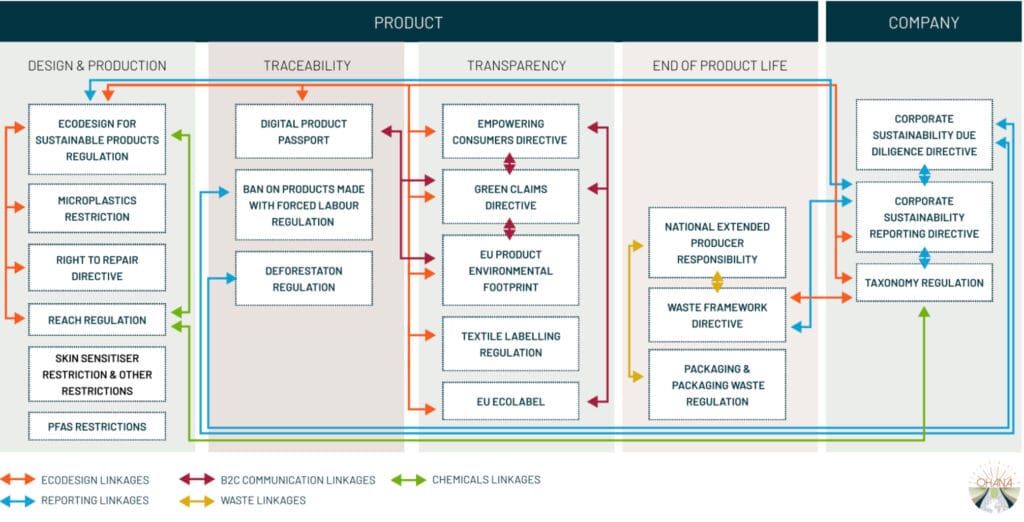
Let’s now go through the most recent and important ones.
EU Deforestation Regulation (EUDR)
Requires companies to show that relevant products are deforestationfree and legally produced before they are placed on EU markets. In practice, this requires full upstream traceability, including geolocation data down to individual production plots and risk assessments.
While not explicitly mandating endtoend traceability, the regulation effectively requires it in highrisk contexts. Companies must be able to understand and evidence their supply chains if investigations are triggered by authorities.
Corporate Sustainability Due Diligence Directive (CSDDD)
CSDDD embeds due diligence, accountability, and transparency into corporate governance. Traceability becomes a practical enabler of risk prevention and mitigation, while public reporting obligations reinforce transparency.
Corporate Sustainability Reporting Directive (CSRD)
Although CSRD does not impose formal traceability requirements, it significantly raises expectations around multitier data collection and disclosure. Recent Omnibus I updates narrow scope but prioritise quantitative datapoints, enhancing crosssector comparability.
Packaging and Packaging Waste Regulation (PPWR)
PPWR strengthens transparency through extensive reporting obligations (notably under Extended Producer Responsibility schemes) and new labelling rules, even if it stops short of mandatory batchlevel traceability.
Requirements under the Empowering Consumers for the Green Transition Directive further reinforce the need for credible, verifiable data to substantiate voluntary sustainability claims.
What EU Traceability and Transparency Rules Mean for Companies
The convergence of transparency and traceability requirements means increased complexity, brings potential risks, but also wider opportunities to act first and also to enhance regulations through engagement in the process:
- Rising operational complexity: Systems must handle deeper, more granular data across multiple supply chains.
- Supplier engagement becomes critical: Compliance increasingly depends on upstream actors with varying capacities.
- Data reliability becomes a strategic risk: Companies are exposed to the accuracy of data they disclose – often based on information outside their direct control.
- Limited standardisation: Interoperability challenges persist as systems evolve.
- Firstmover advantage: Early investment in robust traceability architectures improves regulatory resilience.
- Internal collaboration is essential: Legal, compliance, procurement, IT, and sustainability teams must work together.
- Opportunity to shape outcomes: Many DPPrelated requirements are still being defined. Early engagement can help ensure proportional and workable rules.
- Balancing transparency and confidentiality: Designing access rights and data layers becomes a strategic decision, not just a technical one.
At the same time, a unified approach can deliver efficiencies. Rather than building regulations pecific solutions, companies can develop integrated traceability infrastructures capable of supporting multiple EU requirements – including future DPP obligations.
Taken together, these frameworks point in the same direction: traceability is no longer regulation-specific. It is becoming a cross-cutting capability that underpins compliance, reporting, and market access across EU product legislation.
Related to this article, also see:
– Beyond Compliance: Why a Holistic Traceability Approach Matters for EU Businesses
– EU Supply Chain Compliance: The Global Impact of EU Product Sustainability Legislation