


The EU Packaging and Packaging Waste Regulation (PPWR) is one of the EU’s flagship initiatives to tackle packaging waste and reduce pollution at source, positioning the EU as a frontrunner in regulating packaging sustainability. It introduces harmonised rules on packaging design, labelling, and Extended Producer Responsibility (EPR), fundamentally reshaping how companies design, use, and report packaging across the EU market.
With only three months remaining before the first compliance deadline (August 12th, 2026), companies must begin preparing now to ensure readiness for this new regulatory framework.
At the same time, the EU Packaging and Packaging Waste Regulation is a distinctive piece of legislation: while the direction of travel is clear, its implementation will rely heavily on secondary legislation to define key elements, such as recyclability methodologies and recycled-content reporting. As a result, companies are facing a familiar challenge: the need to prepare early, while important details are still being defined.
This evolving framework has also made PPWR increasingly politically sensitive. Delays in guidance and FAQs have led parts of the industry to call for a postponement, citing concerns over feasibility, timing, and costs. In contrast, NGOs have urged the Commission to maintain its level of ambition. This tension highlights a central challenge: balancing environmental goals with competitiveness and practical implementation. The debate is no longer whether to strengthen packaging rules, but how quickly and to what extent this transition can realistically take place.
PPWR: Key Takeaways
- PPWR introduces harmonised EU-wide packaging rules
- Compliance responsibility shifts to brands and retailers
- Design, recyclability, and EPR obligations are central
- Secondary legislation will define critical implementation details
What the EU Packaging and Packaging Waste Regulation (PPWR) requires from companies
Harmonisation of EPR Schemes
The Packaging and Packaging Waste Directive (PPWD), originally adopted in 1994 and revised in 2018, mandated all EU Member States to establish Extended Producer Responsibility (EPR) schemes for packaging by December 2024. It also set the EU framework for packaging waste prevention, reuse, recovery, and recycling targets, plus essential requirements for packaging design.
However, persistent fragmentation of rules on both packaging design and EPR obligations across the EU, combined with uneven enforcement, led the Commission to announce in 2022 its intention to revise the Directive and transform it into a Regulation.
This revision resulted in the Packaging and Packaging Waste Regulation (PPWR), aimed at ensuring harmonised implementation across all EU Member States. Greater harmonisation is intended to support the proper functioning of the internal market and facilitate the free movement of packaging and packaged goods throughout the Union.
The move from Directive to Regulation is not just a legal shift: it reflects a clear policy objective: reduce fragmentation and make packaging rules more consistent across the EU.
The PPWR seeks to:
- Establish a consistent definition of packaging and a uniform scope of producer obligations; and
- Ensure that all Member States implement comprehensive and aligned EPR schemes for packaging.
Scope of the PPWR
The Regulation applies to all packaging, regardless of the material used or its intended purpose, and covers the entire lifecycle of packaging, from design and placement on the market to endoflife management. The scope has been expanded to explicitly include ecommerce packaging.
Who is responsible under the PPWR?
Under the PPWR, responsibility for compliance with Extended Producer Responsibility requirements lies with the entity that introduces packaging or packaged products onto the market in a given Member State. In practice, this will most often be brands, retailers, rather than packaging manufacturers or suppliers.
PPWR compliance steps for businesses (by August 2026)
As a result, by August 2026, companies placing packaged products on the EU market must:
- Register in the national producer register of each EU Member State where they place packaged products on the market;
- Appoint an authorised representative in any Member State where they place packaged products on the market without having a legal presence;
- Appoint a Producer Responsibility Organisation (PRO), which is mandated to fulfil EPR obligations on their behalf;
- Prepare a EU Declaration of Conformity for each type of packaging, which must be made available to national authorities upon request; and
- Report annually to their PROs the volumes of packaging placed on the market during the preceding year and pay the corresponding EPR fees.
In practice, this shifts responsibility more clearly onto brands and retailers.
What was previously handled through fragmented national systems is becoming a more centralised and visible compliance obligation. Companies will be incentivised via direct cost implications through eco-modulated fees based on the recyclability performance of their packaging.
PPWR packaging design and performance requirements
In addition to setting common rules on Extended Producer Responsibility, the EU Packaging and Packaging Waste Regulation (PPWR) introduces EUwide sustainability and performance requirements for packaging design. These measures aim to reduce and prevent packaging waste while ensuring a transition towards higher environmental performance across the packaging lifecycle.
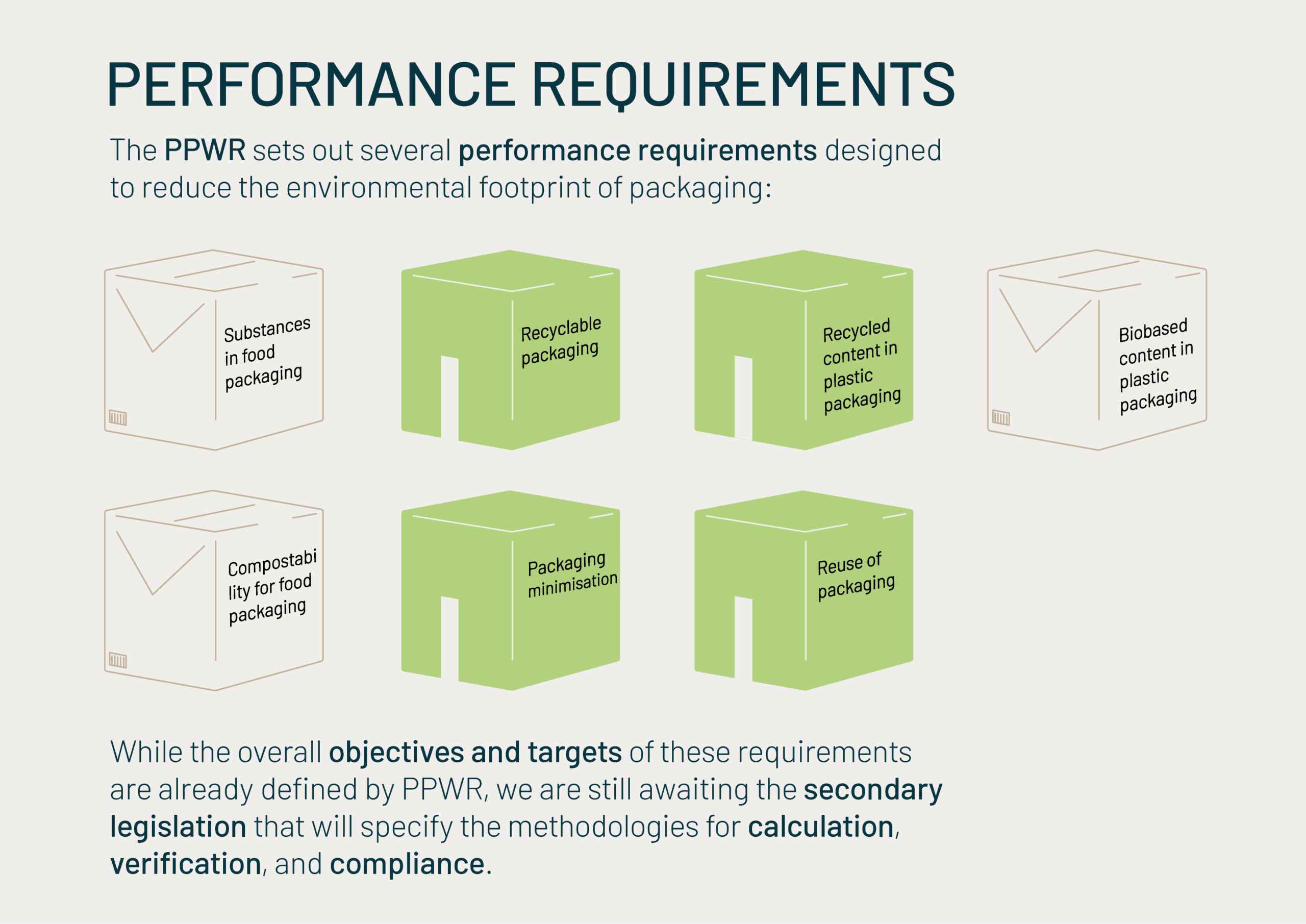
The PPWR establishes a set of core design obligations, including:
- Recycled content requirements for plastic packaging
- From 2030, all non-food-contact plastic packaging, including the plastic components of multimaterial packaging, must contain a minimum of 35% recycled content is required by 2030, increasing to 65% by 2040.
- Recyclability Requirement:
- All packaging must be designed for recycling by 2030, and recyclable at scale by 2035, based on methodologies and technical criteria to be later defined.
- Packaging minimisation requirement:
- By 2030, companies must minimise the weight and volume of packaging, and limit empty space in packaging to 50% max for transport, grouped, and e-commerce packaging.
- Potential biobased content requirement in plastic packaging:
- By 2028, the Commission shall evaluate whether or not to introduce a biobased content requirement on plastic packaging.
- Restrictions on chemical substances used:
- By August 2026, food-contact packaging placed on the EU market must not contain PFAS above a set limit.
- The European Commission will assess, through a dedicated study, whether certain substances hinder the reuse or recyclability of packaging and may introduce further restrictions under the recyclability requirements.
The PPWR also harmonises labelling requirements across the EU, including the introduction of mandatory harmonised sorting labels to improve enduser waste sorting by August 2028. National labelling schemes will be prohibited, ensuring a single, consistent system across the Single Market.
Beyond these requirements, the PPWR introduces measures to reduce packaging waste generation across the EU, including:
- Reusability targets for transport packaging:
- At least 40% reusable by 2030, increasing to 70% by 2040.
- 100% reusability by 2030 for intracompany and intraMember State transport packaging.
Taken together, PPWR compliance implies a significant shift: packaging is no longer just about compliance at end-of-life, but about performance across its entire lifecycle, from design to re-use.
Secondary legislation will be key
While the PPWR sets out clear objectives and headline targets, many key elements, such as methodologies, calculation rules, verification criteria, and enforcement mechanisms, will be defined through secondary legislation, expected from 2026 onwards. As a result, the practical application and level of ambition of several requirements will ultimately depend on these forthcoming implementing and delegated acts. This element of uncertainty, which will only be clarified through secondary legislation, creates a familiar tension for companies: the need to prepare early, while key details are still evolving.
In addition, responsibility for compliance with these sustainability requirements rests with the companies placing packaged products on the EU market, rather than with packaging suppliers. All these requirements mean that companies must continuously monitor developments related to the PPWR.
Traceability and data requirements under the PPWR
Traceability is becoming a core requirement under the PPWR: to comply with the PPWR including EPR obligations and design requirements, companies must put in place robust traceability systems. These systems must enable companies to:
- identify where and how packaging is used across their operations.
- track where packaged products are placed on the EU market.
Effective compliance also requires close and structured cooperation with packaging suppliers. Companies will need to obtain detailed and reliable information from their suppliers in order to meet the PPWR’s sustainability and design requirements. This information is essential to substantiate compliance with the required documentation and to respond to requests from national competent authorities.
Conclusion
The PPWR is a fundamental shift in EU regulation on packaging. And, whilst it sets a clear direction of travel, key elements will continue to be shaped through secondary legislation. There are core obligations, under the PPWR, already sufficiently defined to require action – and soon!
Companies that treat PPWR as a forward-looking transformation, embedding traceability, redesigning packaging portfolios, and aligning internal responsibilities, will be better positioned to manage both regulatory risk and cost exposure. Those that delay, waiting for full clarity, risk facing compressed timelines and higher implementation burdens as the framework comes into force.
At Ohana, we support companies in monitoring and engaging with EU policy, and in preparing for the implementation of EU legislation in a fast-moving environment.
If you would like to discuss what is happening in Brussels and what it means for your organisation in practice, feel free to get in touch.