

The Digital Product Passport (DPP) is set to become a central component of EU product regulation under the Ecodesign for Sustainable Products Regulation (ESPR). It will require companies to make key product information accessible across the value chain; from material composition to repairability and environmental performance.
While detailed rules are still being developed, the direction is clear: companies will need to build systems capable of managing, verifying, and sharing product data at scale.
The process is also starting to move from policy design to implementation. In April 2026, the European Commission published a draft Implementing Act on the DPP registry, the central infrastructure that will store key identifiers and connect products to their digital passports. The registry will not host the full DPP data, but it will be essential for making the system operational: it will support registration, verification, access management and links between product identifiers, economic operators and the relevant DPPs.
This shift is also visible in the standardisation work. In late May 2026, CEN and CENELEC published the first six core European standards for the DPP. These cover key technical elements – including identifiers, data carriers, data exchange, data storage, APIs (the digital interfaces that allow different systems to talk to each other and exchange data) and interoperability. The standards provide a common foundation for implementation of the DPP across sectors.
In other words, the DPP is no longer just a policy concept: the first operational building blocks are now being put in place.
Following our recent cross-cutting analysis of what EU regulations now apply to business beyond agri-food, this article explains how the Digital Product Passport is expected to work in practice, what key design questions remain open, and what companies should prepare for now.
The Digital Product Passport: Quick Guide
- The DPP will require companies to provide structured product-level data
- It will apply across multiple sectors under the ESPR
- Requirements will be defined through delegated acts, starting from 2027
- It will affect how companies collect, manage, and share product information
Why the Digital Product Passport matters for companies
The Digital Product Passport, introduced under the ESPR, is one of the EU’s most ambitious attempts to bring transparency into practice. It aims to encourage sustainable and circular product design, while making key product information reliably accessible.
In practice, the DPP introduces a new layer of product-specific traceability, requiring data from multiple tiers of the supply chain. The scope will vary by product group. For textiles, for example, disclosures may include durability, recyclability, environmental footprint, substances of concern, reparability, and manufacturing-level impacts.
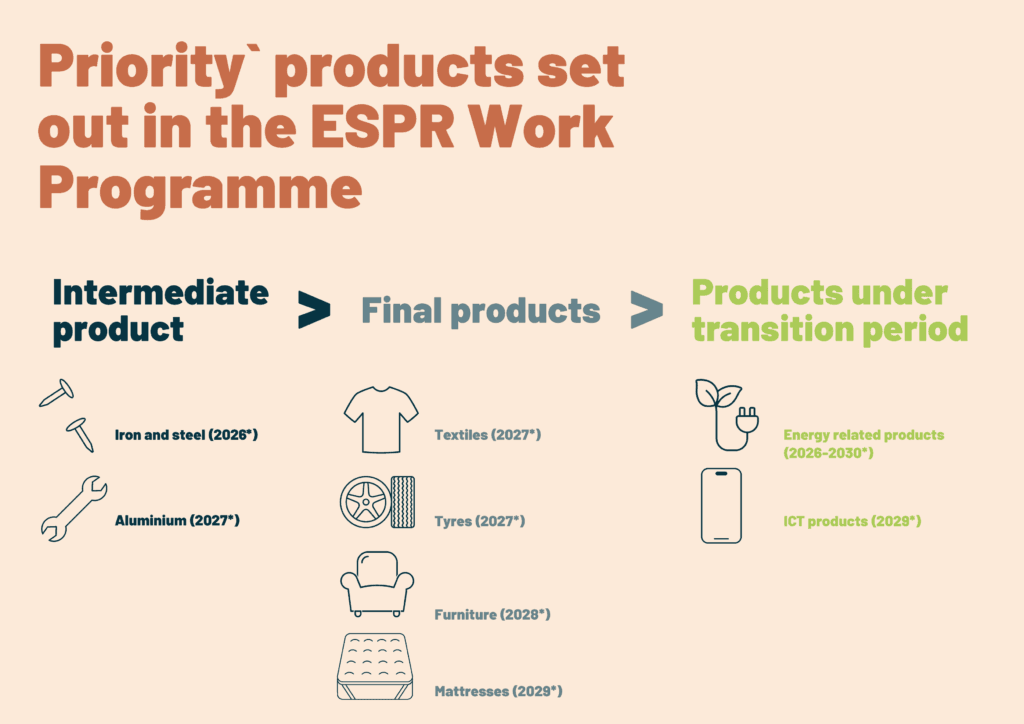
While delegated acts defining the detail are still under development, DPP requirements for multiple final and intermediate product categories (including textiles, tyres, iron and steel, aluminium and more) are expected to be phased in from 2027 onwards.
How the Digital Product Passport (DPP) Will Work In Practice
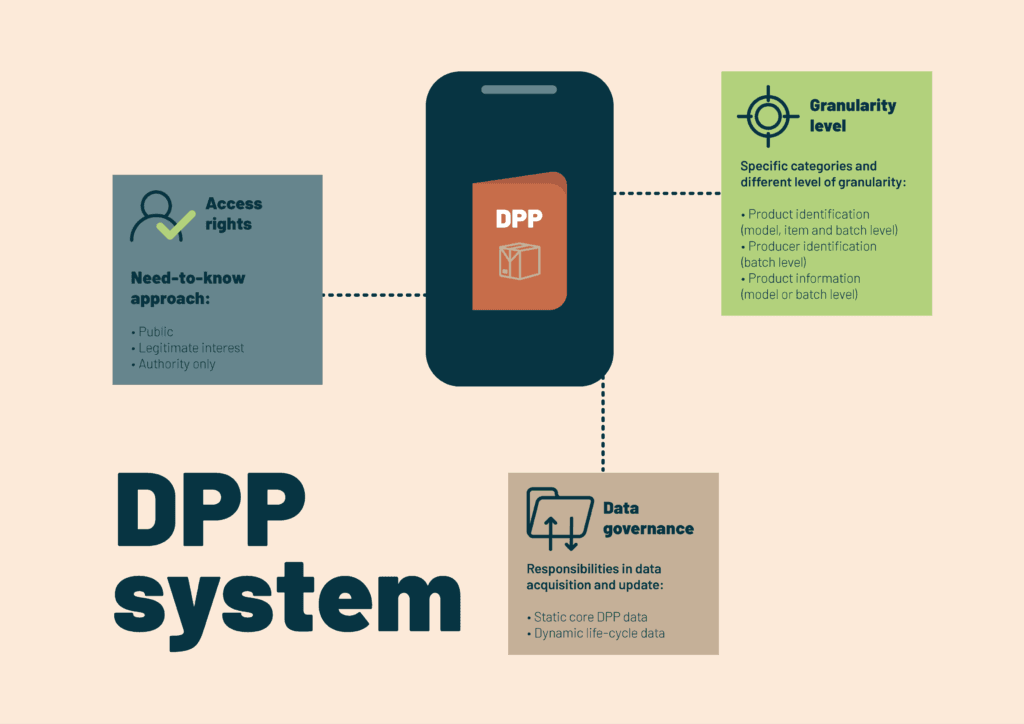
How the DPP likely works in practice will depend on how product data is structured, accessed and governed across the value chain. Three aspects are likely to be particularly important: data granularity, access rights and data governance. Interoperability will cut across all the three.
1. Data granularity
One of the key open questions is how detailed this data needs to be in practice. Data can be collected at different levels of detail. On one hand, model-level data applies to all identical products and is generally the easiest to manage. On the other hand, batch-level data refers to a specific production run, allowing for a more targeted level of traceability.
The most detailed level is item-level granularity, which relates to a single, uniquely identifiable product. While item-level granularity provides a high level of detail, it is also the most demanding to implement in practice. For this reason, a more layered approach is often discussed, where information that does not change over time – such as general product characteristics or average environmental performance – can sit at model level, while more dynamic aspects, such as repair history or end-of-life handling, would require identifiers at a more detailed level.
At this stage, the possibility to choose data granularity according to the specific data category is still assessed, as final measures will be set by the textile delegated act, expected by late 2027. The three main data categories are:
- Product identification, with data points potentially sitting at model, item and batch level
- Producer identification, with data points potentially sitting at batch level
- Product information, with data points potentially sitting at model or batch level.
This distinction is not yet fixed and will likely depend on the purpose of the data, the feasibility of collection and the level of traceability required, allowing for a balance between practicality and more detailed tracking over time.
2. Controlled access
The DPP is expected to rely on different levels of access, broadly following a need-to-know logic. Manufacturers, repairers, recyclers, authorities, and consumers will not see the same data, as carefully designed access rights aim to limit administrative burden and protect commercially sensitive information while ensuring usability for compliance and decisionmaking. Different layers of access will be granted by creating specific categories of users and by linking them only to the most relevant data points. Three levels of access are considered:
- Public (identifiers and product information considered relevant for consumers).
- Legitimate interest (for actors that need access to certain data to perform a specific role, such as repair or recycle)
- Authority only (conformity assessment certifications)
3. Data governance and responsibility
Clear rules will be needed on who creates, verifies, updates, and enriches data over time. One possible approach is to distinguish between static data declared when the product is placed on the market (the “core DPP”) and dynamic life-cycle data generated afterwards (the “life-cycle log”). Different actors may therefore be authorised to add information to the life-cycle log under specific conditions, which are expected to be further defined for each product group through the delegated act.
On top of these three technical aspects, the DPP should not become yet another standalone system. Its value depends on interoperability with existing identifiers, labelling schemes, databases, and regulatory frameworks. Without sufficient standardisation, the risk is that the DPP adds complexity rather than acting as an entry point for product information. In addition, early designs suggest that passports will be built around the product and the company placing it on the market, potentially extending visibility to specific production facilities and selected upstream stages. The final scope will depend on how product-specific requirements are defined.
Case study example – what could a textile DPP look like?
The textile sector gives a useful example of how the DPP may work in practice. The JRC has recently presented a first proposal for textile DPP content, as part of the preparatory work feeding into the future ESPR delegated act for textiles. This is not yet the final legal framework, but it gives an indication of the type of information being assessed: product and producer identifiers, fibre and material composition, manufacturing location, care and repair information, recyclability, substances of concern and, potentially, environmental footprint indicators. These data points are linked to the wider design options currently being discussed under the ESPR process for textiles, including durability, recycled content and recyclability.
A textile DPP will not necessarily mean that every single garment has a completely separate set of data from scratch. The latest JRC study on textile apparel points towards a more layered approach, where information is organised at the level where it makes most sense.
Take a simple example: a white organic cotton T-shirt, size M. Some information would likely be shared by all products of the same model, such as product name, fibre composition, care instructions, product category and general recyclability information. This type of information could sit at model level. Other information may depend on the production batch. If the same T-shirt model is produced in different factories, at different times, or under different certificates, the DPP may need to distinguish between Batch A and Batch B. Batch-level information could include the manufacturing site, production period, relevant certification or testing evidence, and potentially information linked to substances, dyes or finishing processes.
This is why the JRC’s latest work on textile DPPs points towards a layered approach: model-level information where the data is stable, batch-level information where production-specific details matter, and voluntary item-level identifiers where companies want to support more advanced uses such as resale, repair or reverse logistics. The practical result is that a DPP does not have to become an individual “digital diary” for every single T-shirt from day one. Instead, it can be structured around the information that is actually needed, at the level where that information can be collected and verified.
Preparing for the Digital Product Passport: from compliance to data readiness
For companies, the DPP should not be treated as something to only address only once the final rules are adopted. The publication of the draft IA on the DPP registry shows that the system is beginning to take shape in operational terms. At the same time, the JRC’s work on textiles shows that key design choices – especially granularity, access rights and data governance – will determine whether the DPP becomes a useful framework for product information or an additional source of complexity.
Much of the work will start earlier: knowing what product data is already available, where it sits, and whether it can be linked to the right model, batch or item. It will also require clearer internal ownership who checks the data, who gets it from suppliers, who updates it, and who decides what can be public and what should remain restricted. In practice, this means starting with what companies already have: mapping existing product data, identifying gaps, and clarifying internal ownership.
Seen this way, the DPP is more than another compliance requirement. It will test how well companies manage product information across the value chain. Those that prepare early will be in a better position to control costs, avoid duplication and use the DPP as a tool for transparency, circularity and consumer engagement, rather than as an additional reporting burden.
Related to this article, also see:
– Why EU transparency and traceability requirements now matter far beyond agri-food
– EU Supply Chain Compliance: The Global Impact of EU Product Sustainability Legislation
At Ohana, we support companies in monitoring and engaging with EU policy, and in preparing for the implementation of EU legislation in a fast-moving environment.
If you would like to discuss what is happening in Brussels and what it means for your organisation in practice, feel free to get in touch.